

What are modals in English grammar?
Modal verbs are a class of verbs used to to express ideas such as intention, probability, ability, or to give advice. They always appear with the main verb. You can call them helper verbs.
Modal verbs always come directly before the main verb (except in questions). With modal verbs, use the infinitive form of the main verb without “to”.
How do you add a modal verb before a verb?
After the modal verb, use the word “be” followed by the “in” form of the main verb. For example:I should be going“. You can add a modal verb before a verb in the present perfect continuous without changing much.”
When a modal verb is part of a verb phrase in a sentence, it comes first after the subject and (1) is followed by a main verb in the base form (Subject + modal + verb primary +…): “She can play the flute.” or (2) is followed by an auxiliary verb (be, do, have): “He could be watching television now.”
How are modal verbs used in English?
Modal verbs always come directly before the main verb (except in questions). With modal verbs, use the infinitive form of the main verb without “to”. So, suppose you want to boast about your ability to eat a whole pizza. In that case, take the infinitive form of “eat” without “to,” which is “eat,” and add the modal verb “can” before the verb “eat.” “I can eat a whole pizza.”
Can modal verbs be used with future tenses?
The truth is that most future tenses already use modal verbs because they use “will”. If you want to use a different modal verb, such as “can” or “should”, you can use it normally with the infinitive form of the verb and without “will”.
What is a future tense modal?
Modals in the future tense take different forms depending on the future tense. The most commonly used modal in the future tense is WILL, while SHOULD and SHALL are also used. For example: “I think I will go to a movie tonight.”
Conclusion
Modal verbs are used together with the verb main verb of the sentence. Modal verbs show possibility, intention, ability, or necessity. Common examples include “can,” “should,” and “must.”.
Modal verbs can be tricky, especially when used in a sentence. The good news is that they’re easy once you learn how they work.
Modal verbs express hypothetical conditions, such as advice, abilities, or requests. They are used with the main verb to slightly alter its meaning. (A modal verb should only appear if the main verb is clearly identified in the context.). Because they are auxiliary verbs, they cannot be used independently..
Consider the difference between these two examples:
I swim every Tuesday.
I can swim every Tuesday.
The first example is a simple factual statement. The speaker participates in a swimming activity every Tuesday.
The second example uses the modal verb “can”. Notice how the meaning changes slightly. The speaker doesn’t swim every Tuesday, but is capable of swimming every Tuesday if he has to. It’s hypothetical.
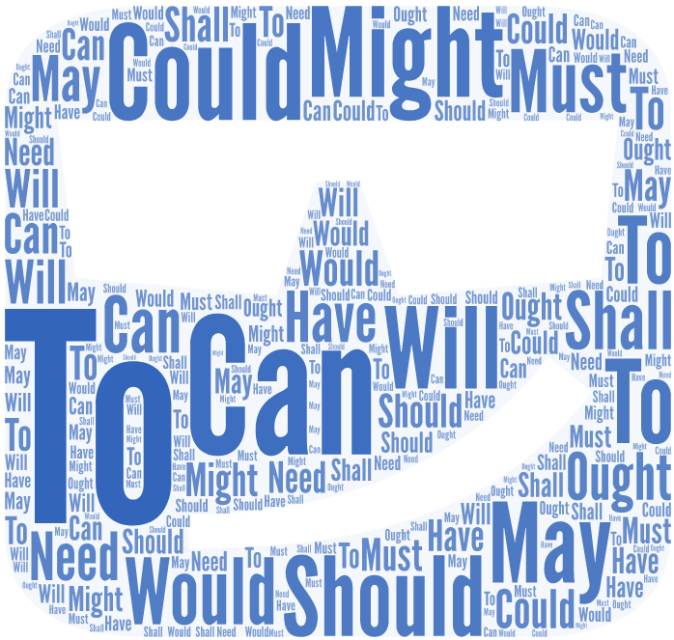
Modal verbs are quite common in English, and you’ve probably seen them hundreds of times without knowing their names. The most commonly used ones are:
| dog | should |
| may | would |
| might | will |
| could | must |
There are more modal verbs, although the ones mentioned above are the most common. Some modal verbs are outdated and rarely used, such as “shall” and “ought to,” while others are more colloquial, such as “got to,” “need to,” or “have to.” Some express specific conditions that don’t often arise, such as “I dare say.” The phrase “used to,” as in “I used to be an English teacher,” also functions as a modal verb.
When are modal verbs used?
What special conditions do modal verbs exhibit? Here is a list of when to use modal verbs, along with examples:
Probability
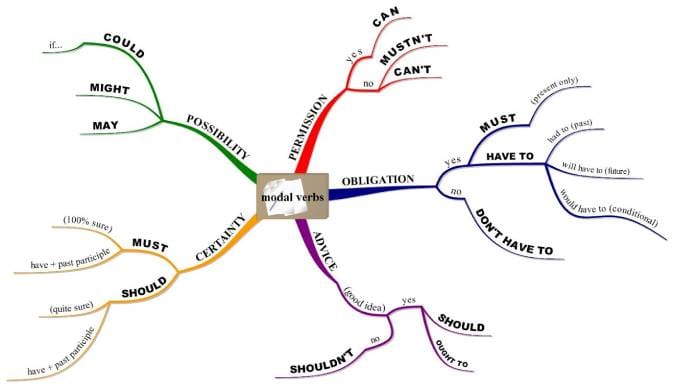
Some things seem likely, but we don’t know for sure. In these cases, you can use the modal verb “should” or “must.” It shows probability without certainty.
His partners must be so proud.
My mother should be asleep by now.
Possibility
When something is possible but not certain, use the modal verbs “could”, “may” or “might”.
Judging by the figures, this might be a challenging year for the company.
Linda May become the youngest pro tennis player ever.
Ability
Modal verbs can show whether the subject can do something, such as perform an action or demonstrate a skill. Similarly, the negative form, “cannot” or “cant,” shows that the subject is unable to do something.
She can speak four languages, but none of them well.
You can lead a horse to water, but you cannot make it drink.
Ask for permission
Traditionally, in a more formal and polite usage, “may” is used to ask for permission. However, the modern usage of “may” and “can” is perfectly acceptable when describing possibility or permission. If you want to ask for permission to do something, begin your question with “can,” “may,” or “could.” For example:
May I take the earlier flight today?
Could I join too?
Ask
Similarly, if you want to ask someone else to do something, start your question with “will”, “would”, “can”, or “could”.
Would you get your car out of the driveway?
Will you start the meeting?
Suggestion/advice
What if you want to recommend something, but not order it? You can use the modal verb “should” or “would” if you are giving suggestions or advice without ordering someone to do it.
It would be best if you tried the way Martin suggested.
Tom should submit his work on time.
Send
On the other hand, if you want to order someone to do something, use the modal verbs “must”, “have to”, or “need to”.
You must wash your hands before cooking.
You need to finish the meeting before 6:00.
Obligation or necessity
Modal verbs can express a necessary action, such as an obligation, a duty, or a requirement. Similarly, the negative form states that an action is not necessary. Use the same modal verbs with commands: “must,” “have to,” or “need to.”
We must check the flight prices before we book our holiday.
You do not need to bring Guillermo if you don’t want to.
Habit
To show an ongoing or habitual action, something the subject does regularly, you can use the modal verb “would” for the past tense and “will” for the present and future. The phrase “used to” It’s also acceptable if you’re talking about a habit that no longer exists.
When I lived in San Francisco, I would eat at Japan Town every Sunday.
I will arrive early at work every day.
How to use modal verbs (with examples)
Fortunately, using modal verbs in a sentence is quite simple. For basic sentences, the simple present tense,
Rrememberto These rules:
- Modal verbs always come directly before the main verb (except in questions).
- With modal verbs, use the infinitive form of the main verb without “to”.
Present tense
You can use modal verbs in the tenses present continuous and present perfect continuous.
Present continuous
After the modal verb, use the word followed by the -ing form of the main verb.
[modal verb] + be + [present participle -ing]
Jim should be going
Present perfect continuous
You can add a modal verb before a verb in the present perfect continuous tense without much change. However, when using a modal verb, you must always use “have” or “had,” even if the subject is in the third person.
[modal verb] + have been + [present participle -ing]
Isabel must have been waiting a long time.
Past tenses and present perfect
Putting a modal verb in the tenses past simple, past continuous and perfect presents It’s more complicated.
To begin, two modal verbs, in particular, have a simple past tense: “can” and “will”. If you want to use either of them in any of the past tenses, you must first change them to their past tense form:
- can-> could
- will -> would
The others remain the same, although some cannot be used in the past tense. These are mainly for speculating about the past, such as asking “what if…”. Modal verbs often deal with hypothetical situations, so if an action has already occurred in the past, it cannot be hypothetical.
None of the modal verbs can be used in the past perfect either past perfect continuous.
Simple past
Of the main modal verbs listed above, only “can” and “will” can be used in the simple past. “Have to” and “need to” can also be used, as long as they are changed to “had to” and “needed to.” Other modal verbs use the present perfect to discuss past events.
“Can” and “will” will use their past tense form plus the infinitive form of the main verb without “to”, just as in the present tense.
could/would + [infinitive]
William could play cricket well when he was a kid.
During a long-haul flight, I wouldn’t sleep much.
Past continuous
You can only use “can” and “will” in the past continuous. It is formed the same as the present continuous, except with the past tense form of the modal verb..
could/would + be + [present participle -ing]
I could be playing golf right now. (He could be playing golf right now.)
Present perfect
Instead of using the infinitive form of the main verb, use the present perfect, which is “have” plus the past participle. As mentioned earlier, you should always use “have,” even if the subject is in the third person.
If you are using “can” you can use its past tense form, which is “could”.
[modal verb] + have + [past participle]
I might have gone to the party, but I forgot.
Future times
The truth is that most future tenses already use modal verbs because they use “will”. If you want to use a different modal verb, such as “can” or “should”, you can use it normally with the infinitive form of the verb and without “will”.
I can sleep in my daughters house tomorrow.
Should I do my PhD next year?
Manners include pure modals and semi-modals. While CAN, COULD, MAY, MIGHT, MUST, SHALL, SHOULD, WILL and WOULD are pure modals, HAVE TO and SHOULD TO are semi-modals.
Modals in the future tense take different forms depending on the specific future tense. While modals in the past and present tenses are simpler, using modals in the future tense can be more complicated. The most commonly used modal in the future tense is WILL, while SHOULD and SHALL are also used. Here are some examples:
“I think I will buy that dress today.”
This sentence is in the simple future tense, and the form is “will” or “shall” + base form. Here, the decision made in the present determines an action in the future.
“Maria will be starting her piano lessons tomorrow.” This is a sentence in the future continuous tense that takes the form “will” or “shall be” + -ing. Here, the statement in the present tense tells when an action will begin in the future.
“I will have already finished my workout in the gym by the time you finish your work.” This sentence in the simple future perfect tense takes the form “will have or shall have” + past participle. Here, the statement in the present tense tells when the action ends at a specific time.
“Mrs. Jones will have been cooking dinner for hours when her husband returns from the office.” This is a future perfect continuous sentence that takes the form “will have been” or “shall have been” + -ing. Here, the present tense statement tells how long an action will have been happening at a specific time.
EBC's Courses Index
Choose the EBC course that best meets your requirements

Exam Prepartion Courses

English classes with a teacher

Online English Courses

Teacher Training Courses